 Jun 02, 2025
  Accounting
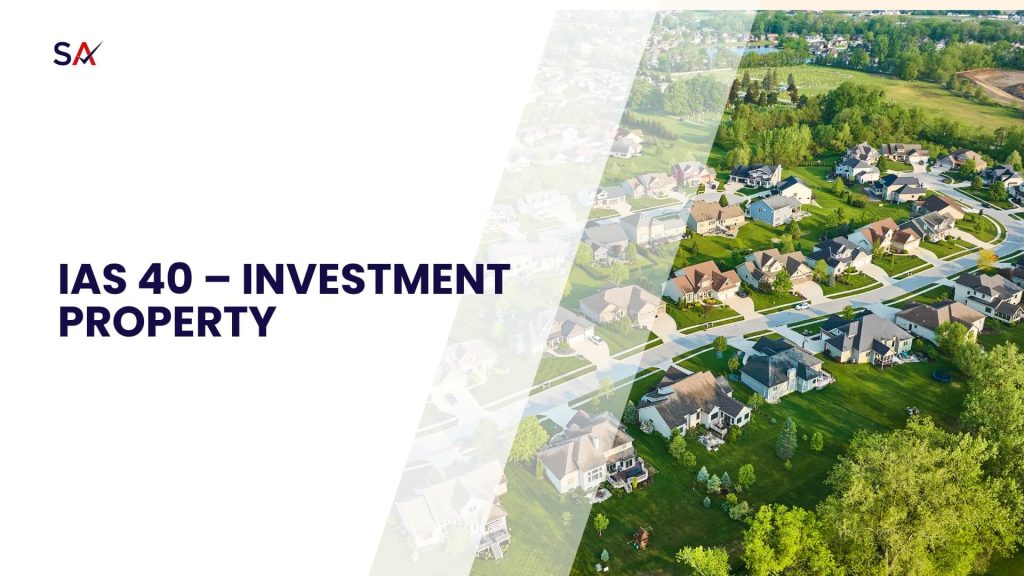
IAS 40 – INVESTMENT PROPERTY
- What is Investment Property?
- According to IAS 40, investment property is property (land or a building—or part of a building—or both) held by the owner or by a lessee under a finance lease to:
- Earn rental income,
- And/or for capital appreciation
- Investment property excludes:
- Property held for use in production or supply of goods or services (→ IAS 16)
- Property held for sale in the ordinary course of business (→ IAS 2)
- Initial Recognition
Investment property shall be recognized as an asset when:
- It is probable that future economic benefits associated with the property will flow to the entity; and
- The cost of the property can be reliably measured
- Initial Measurement
- Investment property is measured initially at cost, which includes:
- Purchase price
- Directly attributable costs (e.g. legal fees, property transfer taxes, professional fees)
- Excludes:
- Start-up costs
- Abnormal losses
- Initial operating losses
- Subsequent Measurement
After initial recognition, an entity must choose either:
- Fair Value Model
- Cost Model
- Fair Value Model
- Investment property is remeasured to fair value at each reporting date.
- Changes in fair value are recognized in profit or loss.
- No depreciation is charged
- Cost Model
- Carried at cost less accumulated depreciation and impairment
- Same treatment as IAS 16 but classified separately.
Note: The model selected must be applied consistently to all investment properties
- When Can You Transfer In or Out of Investment Property?
Transfers into or out of investment property should only be made when there is a clear and documented change in use of the property.
The standard requires objective evidence of this change.
This ensures that entities don’t manipulate earnings by shifting property values between categories without justification.
From | To | Justification (Change in Use) |
Owner-occupied property (IAS 16) | Investment property | Owner stops using the building and starts leasing it out |
Inventory (IAS 2) | Investment property | Developer decides to hold unsold units for long-term rental |
Investment property | Owner-occupied property | Entity moves into the property for internal operations |
Investment property | Inventory | Plans change to sell the property in the ordinary course of business |
- How to Differentiate IAS 40, IAS 16 and Other Related Standards
- IAS 40 – Investment Property
- Used to earn rentals or held for capital appreciation.
- Can apply fair value model (P&L reflects market revaluation).
- Key Indicator: Entity does not occupy or use the property for admin or production.
- IAS 16 – Property, Plant and Equipment
- Used in production, admin, or supply of goods/services.
- Subject to depreciation and impairment.
- Not for passive rental income or speculative capital gain.
- IAS 2 – Inventories
- Property developed or held for sale in the normal course of business.
- IFRS 5 – Non-current Assets Held for Sale
- Applies when a plan to sell the property is in place.
- Sale expected within 12 months.
- Measured at lower of carrying amount or fair value less costs to sell.
Purpose of Property | Standard | Key Accounting Focus |
Held to earn rental income or capital gain | IAS 40 | Measured at fair value or cost model |
Used in operations (admin, production) | IAS 16 | Measured at cost less depreciation |
Held for sale in ordinary course of business | IAS 2 | Inventories: Measured at lower of cost or NRV |
Non-current asset held for sale | IFRS 5 | Measured at lower of carrying amount or FV–costs |
- Derecognition of Investment Property under IAS 40
- Under IAS 40, investment property is derecognized when:
- It is disposed of (i.e. sold, exchanged, or legally transferred), or
- No future economic benefits are expected from its use or disposal.
Special Scenarios
- Exchanging Property
- If investment property is exchanged for another asset, derecognition still applies. Measure the consideration received at Fair value, unless the exchange lacks commercial substance.
- Demolition or Abandonment
- If property is abandoned or demolished and no future economic benefit exists, derecognize the carrying amount and recognize a loss in P&L.
Disclosure Requirements
Even after derecognition, IAS 40 requires you to disclose:
- The amount of gain or loss recognized in profit or loss
- Details about the nature of the disposal (e.g., sale, exchange, demolition)
- Any remaining obligations (e.g., warranties or disposal costs)
- Treatment of Investment Property in Group and Individual Financial Statements
In certain situations, an entity may own property that is rented to and occupied by its parent company or another subsidiary. In such cases, the property is not classified as investment property in the consolidated financial statements, as it is considered owner-occupied at the group level. However, from the perspective of the individual entity that owns the property, it qualifies as investment property if it meets the criteria outlined in paragraph 5 of IAS 40. Consequently, the entity that owns the property recognizes and accounts for the property as investment property in its separate financial statements
- Impact of UAE Corporate Tax Law on IAS 40 – Investment Property
IAS 40 Item | IFRS Treatment | UAE Corporate Tax Impact |
Fair Value Gains | Recognized in P&L under FV model | Taxable, even if unrealized, unless the taxpayer elects to recognize gains and losses on a realization basis for Corporate Tax purposes. |
Fair Value Losses | Recognized in P&L | Deductible, even if unrealized, unless the taxpayer elects to recognize gains and losses on a realization basis for Corporate Tax purposes. |
Depreciation (Cost Model) | Systematic over useful life | Tax depreciation may differ; However, Currently depreciation calculated in accordance with IFRS is allowable for tax purposes. |
Rental Income | Revenue in P&L | Taxable if derived from a business activity requiring a license. Rental income from unlicensed activities by natural persons may be excluded from Corporate Tax. |
Disposal Gains | Gain/loss in P&L | Taxable, as capital gains are included in taxable income. |
Initial Recognition | At cost (incl. transaction costs) | Not immediately deductible; capitalized. |
Transfers Between Models | Re-measure at fair value | May trigger tax impact on gains or loss at reclassification. |
Deferred Tax | Temporary differences recognized (IAS 12) | May lead to deferred tax liabilities/assets. Taxpayers can elect to recognize gains and losses on a realization basis for Corporate Tax purposes, affecting deferred tax calculations. |

Why Choose Spectrum Auditing?
At Spectrum Auditing, we go beyond just being an auditing firm; we’re your trusted partner in navigating the ever-evolving landscape of UAE regulations. Here’s what sets us apart:
- Unparalleled Expertise: Our team consists of accredited auditors, management accountants, consultants with in-depth knowledge of UAE laws, ensuring your business remains compliant.
- Streamlined Solutions: We take a comprehensive approach, guiding you through every step of the process, from risk assessment to filing reports.
- International Recognition: Be audits or any type of compliance, we adhere to the highest standards (ISA, IAS, IFRS), providing global credibility.
- Personalized Support: We understand every business is unique. We tailor our services to address your specific needs and answer any questions you may have.
Partner with Spectrum Auditing today. Let’s focus on your success, while you focus on what you do best – running your business.
Contact us today for a consultation at +971 4 2699329 or email [email protected] to get all our queries addressed.