 Aug 16, 2025
  VAT
VAT
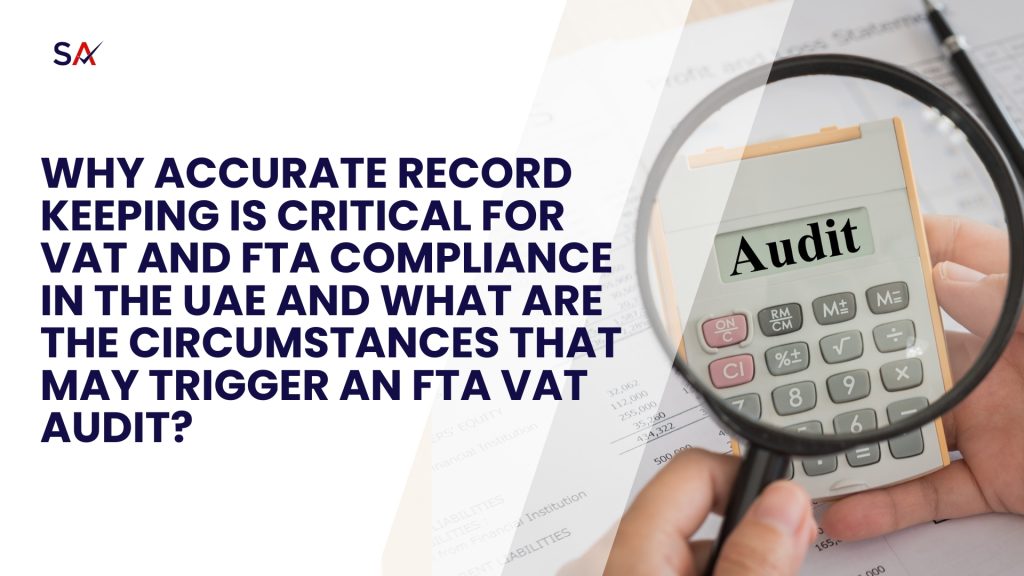
Why Accurate Record Keeping is Critical for VAT and FTA Compliance in the UAE and what are the circumstances that may trigger an FTA VAT audit?
Record keeping compliance in UAE VAT
Keeping accurate records is essential for every business, especially when it comes to VAT administration. It ensures that the business is correctly calculating the VAT it needs to pay or reclaim, reducing the risk of errors and potential penalties. A well-maintained and transparent record system also demonstrates compliance with tax regulations, making it easier for the Federal Tax Authority (FTA) to conduct audits and carry out compliance checks efficiently.
For effective VAT management, businesses are required to maintain specific types of records—such as invoices, credit notes, import/export documents, and accounting books—for a set period as defined by the FTA. These records serve as evidence of business transactions and VAT-related activities, helping taxpayers confirm that the correct amount of tax has been reported and paid. Additionally, they enable the FTA to verify the accuracy of returns and collect any underpaid VAT if necessary. Proper record keeping not only supports regulatory compliance but also contributes to smoother operations and stronger financial control within the business.
How long should the records be kept for VAT purposes?
In general, a taxable person must keep the required records for a minimum of 5 years after the end of the tax period to which they relate.
Where the taxable person owns real estate, the taxable person should retain the required records relating to the real estate for a period of 15 years after the end of the tax period to which they relate.
However, the FTA may require the taxable person to keep the records for an additional
4 years beyond the expiration of 5 years in the following cases.
- ► Tax obligations are subject to an ongoing dispute.
- ► If the Person is subject to an ongoing tax audit
- ► FTA has notified its intention to conduct a tax audit before the expiry of the 5-year retention period.
List of records to be kept
| Transaction records | VAT records | Accounting records |
|---|---|---|
|
|
|
How to ensure proper record keeping?
In order to ensure proper record keeping and comply with the requirements under UAE VAT law, the following methods can be used.
- Use a VAT–compliant accounting system.
- Automate VAT calculations and Invoicing.
- Maintain all required documents.
- Ensure accuracy of tax invoices.
- Track inputs and outputs separately.
- Reconcile records regularly.
- Store records safely and accessibly.
- Keep documents during the retention period.
- Respond promptly to FTA notices.
Archiving and retrieval requirements
Businesses have flexibility in how they maintain their financial records, as there is no mandated format. However, it is essential that these records are organised in a way that allows the Federal Tax Authority (FTA) to easily verify the information used in tax returns. Regardless of the storage method (e.g., physical documents, electronic files, or copies), all records must be readily accessible and legible for FTA inspections. While you don’t have to keep records on-site, you must be able to provide them promptly and efficiently if the FTA requests them, for example, during a tax audit at your business premises.
Penalty for non-compliance in keeping proper tax records under VAT law
requirements
The failure of the Person conducting Business to keep the required records and other information specified in the Tax Procedures Law and the Tax Law will attract a penalty of AED 10,000 for the first time. 20,000 in case of repetition.
FTA compliance check
The Federal Tax Authority (FTA) can conduct a tax audit to confirm a business’s VAT obligations. During an audit, the FTA has the authority to review a business’s required records and inspect its operations. Audits can take place either at the business’s location (a “field audit”) or at the FTA’s offices. Businesses are typically notified in advance. As part of the audit, the FTA is allowed to copy, extract, or take samples of any information or goods they consider necessary.
Why is a tax audit necessary?
VAT audits are necessary because VAT is a “self-assessment” tax. This means businesses calculate and report what they owe or are owed to the tax authority (FTA). An audit is how the FTA checks if those calculations are correct. If an audit finds that a business paid too little VAT, the FTA can demand the extra payment and add penalties.
Circumstances that may trigger an FTA VAT audit include
- FTA may audit businesses as part of routine compliance checks, even without specific red flags.
- Sudden increase or decrease in revenue
- Change in VAT registration status
- Shifts in the nature of business activities
- Significant discrepancies between input and output VAT
- Repeated or unusually high VAT refund claim
- Frequent amendments to previously filed VAT returns.
- Repeated non-compliances with due dates.
- Discrepancies between your VAT records and those of suppliers or customers
- Information mismatch with customs declarations (especially for import/export businesses)
- Large or unusual one-time transactions
- High-value or complex cross-border dealings
- Involvement in sectors considered high risk (e.g., construction, trading, real estate)
How often will a business be audited under UAE VAT law?
There is no set frequency for how often a business will be audited. The FTA does not audit every registered business at a regular interval (e.g., once every two years). Instead, the FTA may use a risk-based approach to select businesses for an audit.
The FTA’s Risk-Based Approach
The FTA may focus its audit resources on businesses that pose the highest risk to public revenue. This is determined by a number of factors, and may include:
- Size and Complexity of the Business: Larger, more complex businesses with a high volume of transactions are more likely to be audited than smaller businesses, as any potential errors would have a greater financial impact.
- Compliance History: Your track record with the FTA is a major factor. Businesses that have previously submitted late returns, filed incorrect returns, or have a history of non-compliance are at a much higher risk of being audited.
- Audit Triggers: The FTA’s system flags inconsistencies and anomalies in your tax returns. This could include:
o Unusual patterns in your taxable supplies.
o Large or unusually high input tax claims.
o Significant discrepancies between your reported income and expenses. - Industry and Sector: Businesses in certain sectors that are considered high-risk or prone to non-compliance may be subject to more frequent audits.
Simple Example:
A large import/export business with a history of filing late VAT returns and a significant change in its declared taxable supplies is much more likely to be selected for an audit.
In contrast, a consultancy firm that consistently files its returns on time and has a clean compliance history is far less likely to face an audit.
The bottom line is that the best way to avoid a tax audit is to maintain excellent record-keeping and ensure timely and accurate VAT filings. This demonstrates a strong compliance record and reduces the risk of being notified for an audit.

Why Choose Spectrum Auditing?
At Spectrum Auditing, we go beyond just being an auditing firm; we’re your trusted partner in navigating the ever-evolving landscape of UAE regulations. Here’s what sets us apart:
- Unparalleled Expertise: Our team consists of accredited auditors, management accountants, consultants with in-depth knowledge of UAE laws, ensuring your business remains compliant.
- Streamlined Solutions: We take a comprehensive approach, guiding you through every step of the process, from risk assessment to filing reports.
- International Recognition: Be audits or any type of compliance, we adhere to the highest standards (ISA, IAS, IFRS), providing global credibility.
- Personalized Support: We understand every business is unique. We tailor our services to address your specific needs and answer any questions you may have.
Partner with Spectrum Auditing today. Let’s focus on your success, while you focus on what you do best – running your business.
Contact us today for a consultation at +971 4 2699329 or email [email protected] to get all our queries addressed.