 Sep 30, 2025
  IFRS
IFRS
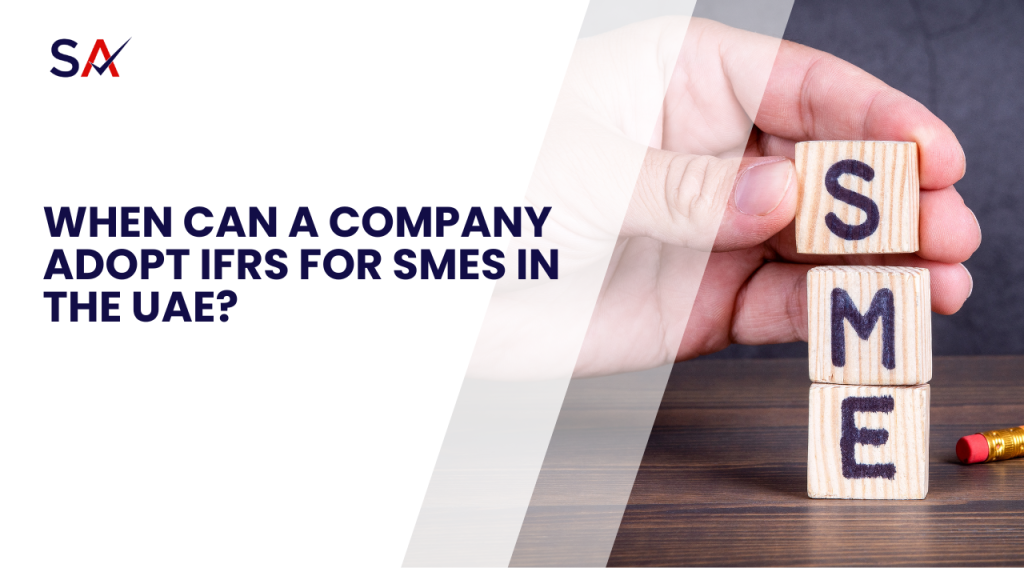
When Can a Company Adopt IFRS for SMEs in the UAE?
In the UAE, most companies are required to prepare their financial statements in compliance with International Financial Reporting Standards (IFRS). However, for many small and medium-sized enterprises (SMEs), the IFRS for SMEs framework offers a practical alternative. This standard is specifically designed for entities that do not have public accountability, reducing the complexity of accounting and disclosure requirements without compromising transparency.
This article explains the eligibility criteria, practical implications, and decision factors for applying IFRS for SMEs, with specific relevance to companies operating in Dubai and across the UAE.
What is IFRS for SMEs?
IFRS for SMEs is a stand-alone accounting standard issued by the International Accounting Standards Board (IASB). It is intended for companies that:
- Are not publicly traded;
- Are not financial institutions (banks, insurance, mutual funds, etc.);
- Prepare general purpose financial statements for owners, lenders, or regulators.
The standard simplifies recognition, measurement, and disclosure requirements compared to Full IFRS. For example, IFRS for SMEs eliminates hedge accounting, mandates cost model for PPE, and significantly reduces disclosure obligations.
Consistency rule
Once management adopts IFRS for SMEs, they must apply it consistently across all aspects of reporting. They can’t say “for leases we follow SME IFRS, but for financial instruments we follow Full IFRS”.
- If an entity claims compliance with IFRS for SMEs, all areas must follow that framework.
- If the entity wants to apply full IFRS, then the entire set of standards must be applied.
- Selective application = misleading, non-compliant FS, and auditor risk.
The Myth of Turnover Thresholds
A common misconception is that only companies with turnover below AED 50 million can apply IFRS for SMEs. In reality, turnover is not a formal criterion under IASB rules.
- A company with AED 40 million turnover can apply IFRS for SMEs if it meets the “no public accountability” test.
- Even a company with AED 200 million turnover can technically apply IFRS for SMEs if it is not listed and not in the financial sector.
That said, in practice, many regulators and auditors encourage larger entities (often those above AED 50–100 million in revenue or with significant borrowings) to adopt Full IFRS, as it better reflects their scale and stakeholder needs.
However, for Corporate Tax purposes, a taxable person may use IFRS for SMEs if they derive revenue not exceeding AED 50 million in a Tax Period.
Criteria for Applying IFRS for SMEs in the UAE
Before recommending or adopting IFRS for SMEs, entities should evaluate:
Step 1 – Public Accountability
- Listed or preparing for IPO? → Must apply Full IFRS.
- Licensed as a bank, insurance, or financial institution? → Must apply Full IFRS.
- Holding client funds in a fiduciary capacity (investment companies, brokerage)? → Must apply Full IFRS.
Step 2 – Group Reporting Requirements
- If the entity is a subsidiary of a group that prepares consolidated accounts under Full IFRS, the group may require Full IFRS reporting.
Step 3 – Regulatory Acceptance
- Most UAE free zones (DMCC, DDA, etc.) and the Ministry of Economy accept IFRS for SMEs for private companies.
- However, some regulators (e.g., DIFC, ADGM) may impose stricter requirements.
Step 4 – Stakeholder Needs
- Banks, investors, or potential buyers may request Full IFRS regardless of eligibility.
- For family-owned or owner-managed businesses, IFRS for SMEs is often sufficient.
Practical Comparison: Full IFRS vs IFRS for SMEs
Area | Full IFRS | IFRS for SMEs | Practical Audit Impact |
Users / Applicability | Publicly accountable entities (listed, banks, insurance, large groups). | Non-listed, private entities with no public accountability. | Auditor must confirm framework selection matches entity’s size and regulatory environment. |
Financial Instruments | IFRS 9: multiple categories (FVTPL, FVOCI, amortised cost), hedge accounting allowed. | Only basic instruments; mostly amortised cost; limited FV; no hedge accounting. | Saves audit hours on complex valuation/disclosure. |
Property, Plant & Equipment | IAS 16 allows cost or revaluation model. | Only cost model. | No fair value exercise required; audit testing simplified. |
Intangibles / Goodwill | Impairment annually, indefinite life intangibles permitted. | Must amortise goodwill and intangibles (max 10 years if life uncertain). | No annual impairment model; simpler amortisation testing. |
Consolidation | IFRS 10 requires full consolidation for subsidiaries. | Requires consolidation, but exemptions for small groups. | Workload reduction where exemption applies. |
Deferred Tax | IAS 12 full temporary difference approach. | Simplified approach; recognition only if probable. | Less complex deferred tax workings. |
Leases | IFRS 16: ROU assets and lease liabilities on balance sheet. | Old IAS 17 model: classify as finance or operating. | Huge saving: no ROU accounting/testing needed. |
Revenue Recognition | IFRS 15: 5-step model, contract-based obligations, variable consideration. | Simplified accrual approach. | Sampling/testing easier (invoice- and shipment-based). |
Disclosures | Extensive, often 40+ pages of notes. | Significantly reduced; only essential disclosures. | Cuts down disclosure review checklists by 20–30%. |
Advantages of IFRS for SMEs
- Simplified accounting treatments (cost model for PPE, amortisation of goodwill).
- Reduced disclosure requirements — often 60–70% less compared to Full IFRS.
- Less frequent amendments (IFRS for SMEs is updated roughly every 3–5 years).
- Time and cost savings for both preparers and auditors.
Decision Flowchart
Is the entity listed or preparing for IPO?
➡️ Yes → Apply Full IFRS
➡️ No → Next test
Is the entity a bank, insurance company, or holding client funds?
➡️ Yes → Apply Full IFRS
➡️ No → Next test
Is the entity required to report to a group that uses Full IFRS?
➡️ Yes → Apply Full IFRS
➡️ No → IFRS for SMEs is permitted
Final Check: Stakeholder Needs
- If banks, investors, or regulators expect Full IFRS → adopt Full IFRS
- Otherwise → IFRS for SMEs is appropriate
Conclusion
IFRS for SMEs is not restricted by a turnover cap such as AED 50 million. The key determinant is public accountability and stakeholder expectations. In the UAE, privately held companies without listing or fiduciary obligations are generally eligible to adopt IFRS for SMEs.
For auditors and advisors, the choice between IFRS for SMEs and Full IFRS should balance regulatory compliance, stakeholder needs, and efficiency. For many SMEs, adopting IFRS for SMEs can significantly streamline accounting and audit timelines without sacrificing quality.

Why Choose Spectrum Auditing?
At Spectrum Auditing, we go beyond just being an auditing firm; we’re your trusted partner in navigating the ever-evolving landscape of UAE regulations. Here’s what sets us apart:
- Unparalleled Expertise: Our team consists of accredited auditors, management accountants, consultants with in-depth knowledge of UAE laws, ensuring your business remains compliant.
- Streamlined Solutions: We take a comprehensive approach, guiding you through every step of the process, from risk assessment to filing reports.
- International Recognition: Be audits or any type of compliance, we adhere to the highest standards (ISA, IAS, IFRS), providing global credibility.
- Personalized Support: We understand every business is unique. We tailor our services to address your specific needs and answer any questions you may have.
Partner with Spectrum Auditing today. Let’s focus on your success, while you focus on what you do best – running your business.
Contact us today for a consultation at +971 4 2699329 or email [email protected] to get all our queries addressed.