 Dec 24, 2025
  VAT
VAT
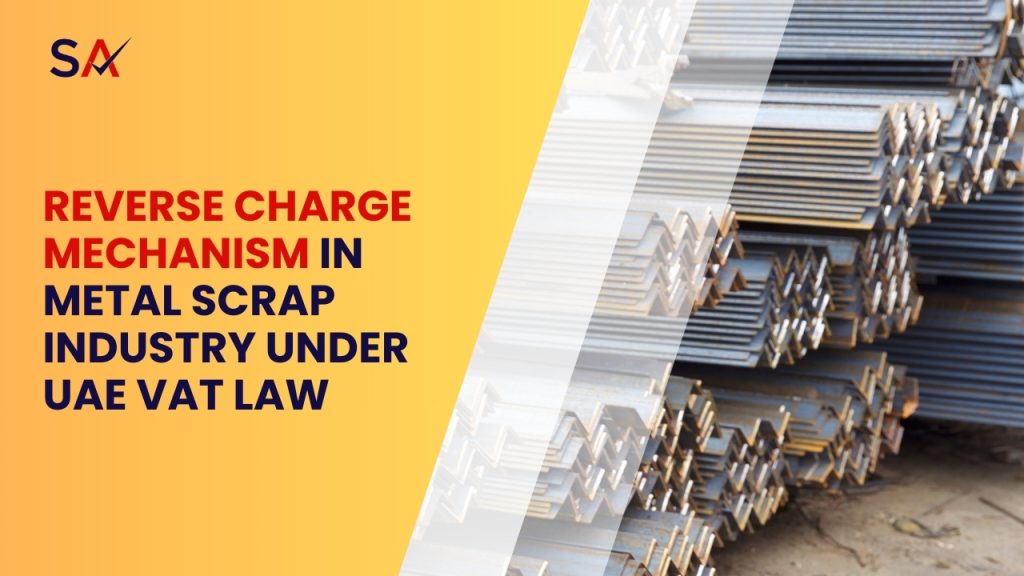
Reverse Charge Mechanism in Metal Scrap industry under UAE VAT Law
(Cabinet Decision No. 153 of 2025 – Issued 4 Nov 2025 – (Effective from 14 January 2026)
The UAE Cabinet has introduced a significant change to the Value Added Tax (VAT) treatment of Metal Scrap transactions through Cabinet Decision No. 153 of 2025, issued on 14 November 2025 and effective from 14 January 2026. This decision mandates the application of the Reverse Charge Mechanism (RCM) on specific Metal Scrap supplies between VAT-registered businesses in the UAE.
This provision was introduced to bring transparency, prevent tax evasion, and ensure better compliance in the scrap industry, which often involves multiple unorganized suppliers. Under RCM, the VAT liability is shifted from the scrap supplier to the recipient, making it essential for buyers to understand their tax responsibilities.
Metal Scrap
“Metal Scrap” refers to ferrous or non-ferrous metal waste that has a commercial value, and is usable after undergoing processing
Processing
“Processing” includes any operation that converts Metal Scrap into materials usable for manufacturing new products. This includes recycling , repairing or any other transformation method
Purpose of this decision
The mechanism is designed to make the tax system more efficient, prevent fraud in the Metal Scrap sector, ensure fair taxation, encourage businesses to comply voluntarily, and support a healthy and competitive business environment in the UAE.
How the reverse charge works
Under the reverse charge mechanism, the buyer, whether purchasing scrap-metal for resale or converting it into materials for new products, becomes responsible for accounting for the VAT due. Suppliers will no longer charge VAT on these eligible supplies.
Application of the Reverse Charge Mechanism
The Reverse Charge Mechanism applies when all the following conditions are met:
- The supply involves Metal Scrap
- The supplier and recipient are both VAT-registered with the FTA
- The recipient intends to resell the Metal Scrap or use it in Processing
When these conditions are satisfied, the VAT liability shifts from the supplier to the recipient.
VAT Responsibilities Under RCM
1. Supplier’s Obligations
When RCM applies:
- The supplier must not charge VAT on the invoice
- The supplier must not report output VAT on this supply in their VAT return
- The invoice must explicitly state that the Reverse Charge Mechanism applies
This effectively removes the supplier’s VAT payment obligation for qualifying Metal Scrap supplies
2. Recipient’s Obligations
The recipient of the Metal Scrap becomes fully responsible for VAT compliance, including:
- Accounting for VAT on the supply as output tax
- Reporting the VAT in their VAT return
- Meeting all tax obligations arising from the transaction
Subject to normal VAT rules, the recipient may also claim input tax if eligible.
Exception: Zero-Rated Supplies
The RCM does not apply where the supply of Metal Scrap is already zero-rated under Article 45(1) of the VAT Law, such as certain qualifying export transactions. In such cases, normal VAT treatment continues to apply.
Mandatory Declarations and Documentation
1. Recipient’s Pre-Supply Requirements
Before the date of supply, the recipient must provide the supplier with two written declarations:
- A declaration confirming that the Metal Scrap is intended for resale or processing
- A declaration confirming that the recipient is VAT-registered with the FTA
These declarations are a mandatory condition for applying RCM
2. Supplier’s Pre-Supply Requirements
Before issuing the invoice, the supplier must:
- Receive and retain the recipient’s written declarations
- Verify the recipient’s VAT registration status using FTA-approved means
- Ensure the tax invoice clearly states that RCM is applied
Failure to meet these conditions may expose the supplier to compliance risks.
Where is it reflected in the VAT summary:
Case 1: When the buyer is VAT-registered and uses the scrap for resale or further processing, the transaction must be reported under Box 3 (supplies subject to the reverse-charge provision) in the output tax section and under Box 10 (supplies subject to the reverse-charge provision) in the input tax section.
Case 2: When the supplier is VAT-registered and supplies scrap to another VAT-registered buyer, the transaction is treated as out of scope for VAT purposes from the supplier’s perspective.
Case 3: When the supplier is VAT-registered and the buyer is not VAT-registered, the supplier must treat the transaction as a standard-rated supply.
Consequences of Non-Compliance
If the recipient fails to provide the required declarations:
- The Reverse Charge Mechanism cannot be applied
- Standard VAT rules may apply, potentially resulting in incorrect tax treatment.
- Penalties may attract for not complying with the VAT law and for incorrect VAT return.

Why Choose Spectrum Auditing?
At Spectrum Auditing, we go beyond just being an auditing firm; we’re your trusted partner in navigating the ever-evolving landscape of UAE regulations. Here’s what sets us apart:
- Unparalleled Expertise: Our team consists of accredited auditors, management accountants, consultants with in-depth knowledge of UAE laws, ensuring your business remains compliant.
- Streamlined Solutions: We take a comprehensive approach, guiding you through every step of the process, from risk assessment to filing reports.
- International Recognition: Be audits or any type of compliance, we adhere to the highest standards (ISA, IAS, IFRS), providing global credibility.
- Personalized Support: We understand every business is unique. We tailor our services to address your specific needs and answer any questions you may have.
Partner with Spectrum Auditing today. Let’s focus on your success, while you focus on what you do best – running your business.
Contact us today for a consultation at +971 4 2699329 or email [email protected] to get all your queries addressed.