 Sep 11, 2025
  Accounting
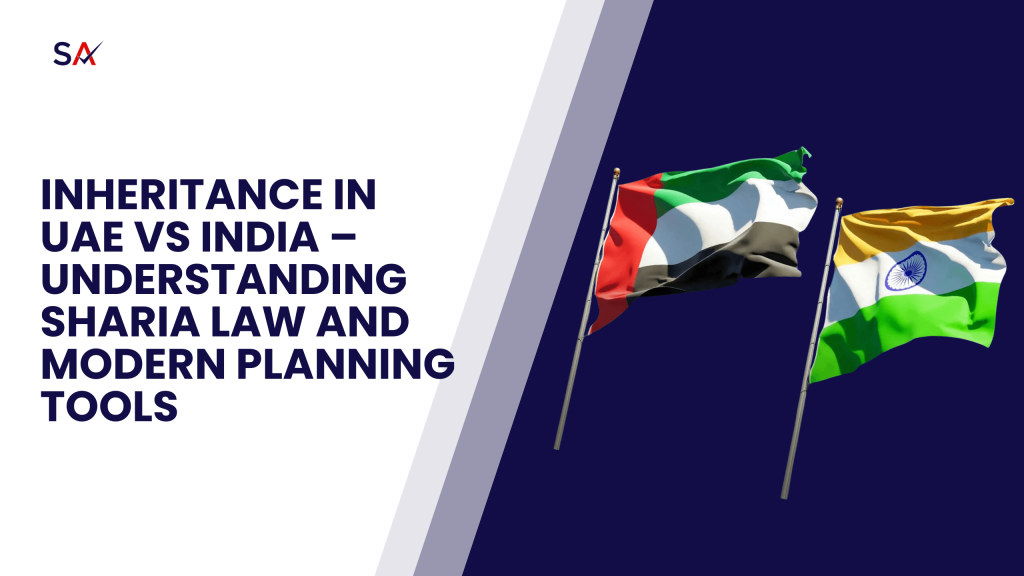
Inheritance in UAE vs India – Understanding Sharia Law and Modern Planning Tools
Introduction
Inheritance is one of the most sensitive topics in family and business planning. While Indian law gives children and spouses a clear right over the deceased’s estate, the UAE follows Sharia law as the default legal framework for inheritance, unless specific steps are taken — such as registering a Will or creating modern planning vehicles like Foundations.
This often comes as a surprise to expatriates and even to UAE nationals managing family-owned businesses.
Indian Law vs UAE Law: The Key Difference
In India
- Inheritance is governed by personal laws depending on religion (Hindu Succession Act, Muslim personal law, Christian law, etc.).
- As a general rule, children and spouse automatically inherit a share of the deceased’s property.
- Example: In Hindu succession, sons and daughters have equal rights to their father’s property.
In UAE
- By default, Sharia law applies.
- Under Sharia, inheritance is distributed according to fixed shares determined by the Quran and Hadith.
- Example: If a man dies leaving behind children, sons get twice the share of daughters. If he leaves no children, assets can pass to the deceased’s brothers or uncles rather than the wife alone.
- This means that in some cases, children and spouse may not inherit everything — shares may go to extended male relatives.
What is Sharia Law in the Context of Inheritance?
Sharia is Islamic law derived from religious sources. In inheritance:
- Shares are predetermined — the court does not distribute according to “will” unless allowed under specific limits.
- A Muslim may only will away one-third of their estate to non-heirs; the rest follows Sharia distribution.
- For expatriates, unless a registered Will or planning structure is in place, Sharia rules apply to UAE-based assets by default.
Using a Will for Inheritance Planning
For many expatriates and even some local families, the simplest way to safeguard assets is through a registered Will.
How it works
- A Will can be registered at the DIFC Courts or Abu Dhabi Judicial Department (ADJD).
- It ensures that the deceased’s wishes are followed and Sharia law does not automatically apply to their assets.
- Parents can specify that property, bank accounts, or company shares pass directly to their spouse and children.
Benefits
- Straightforward, legally recognized solution.
- Cost-effective compared to setting up complex structures.
- Ideal for families with properties, bank accounts, or investments in the UAE.
Limitations
- Still subject to probate (court approval process).
- Not as flexible for succession of family-owned businesses compared to Foundations.
Why Families Use DIFC Foundations
For example, a local Arab family may transfer 90% of company shares into a DIFC Foundation and keep 10% with a senior family member.
What is a DIFC Foundation?
- A legal entity (similar to a trust) created under DIFC Law.
- Can hold shares, properties, or investments for the benefit of family members.
- Founder sets rules in the Foundation Charter and By-laws on how assets are managed and distributed.
Benefits of a Foundation
- Bypasses Sharia inheritance – assets in the Foundation are governed by DIFC laws, not Sharia law.
- Control & Continuity – ensures family business passes smoothly to children/spouse.
- Asset Protection – shields wealth from disputes or creditors.
- Perpetual Structure – unlike a Will, a Foundation does not end with probate.
Other Options to Safeguard Assets
Apart from Wills and Foundations, families often use:
- Joint Ownership of Assets
- Structuring property or bank accounts in joint names allows automatic transfer to the surviving joint holder.
- Helps avoid immediate freezing of assets on death.
- Life Insurance with Assigned Beneficiaries
- Provides liquidity to dependents upon death.
- Often used to cover business loans or family obligations.
- Family Trusts (Offshore / Common Law Jurisdictions)
- Some families create trusts in offshore jurisdictions (like Jersey or BVI) to hold UAE/global assets.
- Offers privacy and long-term asset protection.
- Corporate Structuring
- For business owners, restructuring shareholding through holding companies in DIFC/ADGM can ensure smoother transfer of ownership.
Risks of Not Planning (Example)
If the family did not set up any plan:
- Upon the father’s death, his shares in the LLC would be frozen.
- Sharia distribution may give rights to the father’s brothers/uncles, reducing the share for wife and children.
- This could cause loss of control of the family-owned company.
By placing shares in a Foundation or securing them with a Will, the family ensures continuity, with spouse and children as beneficiaries.
Comparison of Inheritance Planning Tools
Tool | Best For | Advantages | Limitations | Cost & Complexity |
Registered Will (DIFC/ADJD) | Expatriates and families with property, bank accounts, or smaller estates | –Simple & legally recognized | –Still subject to probate | 💲 Low to Medium |
DIFC/ADGM Foundation | Family businesses, multiple properties, or wealthy families | –Bypasses Sharia inheritance | –Higher setup & annual costs | 💲💲Medium to High |
Joint Ownership | Couples or small families with real estate/bank accounts | –Surviving holder gets automatic rights | –Limited to jointly held assets | 💲 Very Low |
Life Insurance (with Beneficiaries) | Families needing liquidity or business loan cover | –Provides immediate cash to dependents | –Only covers insurance payout | 💲 Low (premium-based) |
Offshore/Family Trusts | Global families with UAE & overseas assets | –Long-term asset protection | –More complex structure | 💲💲 High |
Corporate Structuring (Holding Companies) | Business owners with multiple ventures | – Professional succession planning | –More suitable for large businesses | 💲💲Medium to High |
Consultant’s View
As consultants, we always recommend families in the UAE — whether expatriates or locals — to take proactive steps in estate planning. Relying solely on default Sharia inheritance can create unwanted disputes and even cause businesses to collapse.
For Indian families, the assumption that “children automatically inherit” does not hold true in the UAE unless a registered Will or planning vehicle is in place.
For Emirati families, using DIFC Foundations ensures control stays within the intended bloodline and avoids dilution of ownership.
Conclusion
Inheritance in the UAE is a complex interplay between Sharia law and modern legal structures. While Sharia law has fixed principles, the UAE has created progressive mechanisms — Wills, Foundations, Trusts, Joint Ownership — to give families more control.
🔑 The key is planning. Families that prepare today avoid disputes tomorrow.

Why Choose Spectrum Auditing?
At Spectrum Auditing, we go beyond just being an auditing firm; we’re your trusted partner in navigating the ever-evolving landscape of UAE regulations. Here’s what sets us apart:
- Unparalleled Expertise: Our team consists of accredited auditors, management accountants, consultants with in-depth knowledge of UAE laws, ensuring your business remains compliant.
- Streamlined Solutions: We take a comprehensive approach, guiding you through every step of the process, from risk assessment to filing reports.
- International Recognition: Be audits or any type of compliance, we adhere to the highest standards (ISA, IAS, IFRS), providing global credibility.
- Personalized Support: We understand every business is unique. We tailor our services to address your specific needs and answer any questions you may have.
Partner with Spectrum Auditing today. Let’s focus on your success, while you focus on what you do best – running your business.
Contact us today for a consultation at +971 4 2699329 or email [email protected] to get all our queries addressed.