 Nov 27, 2025
  Accounting
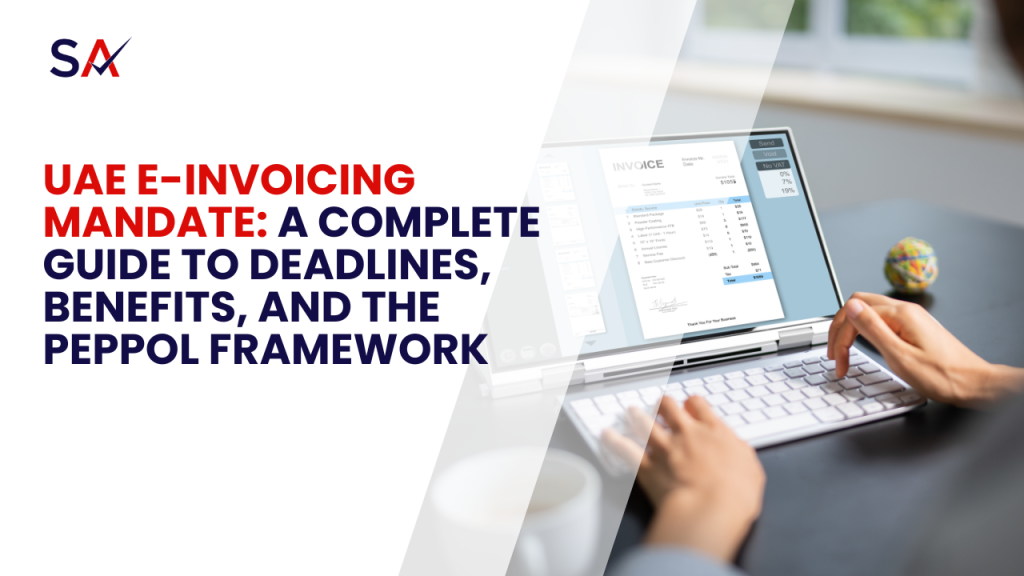
UAE E-Invoicing Mandate: A Complete Guide to Deadlines, Benefits, and the Peppol Framework
E Invoicing
E-invoicing in the UAE is part of the country’s push toward digital transformation and stronger tax compliance. Since introducing VAT in 2018, the UAE government has been modernizing its financial systems to make business processes smoother, increase transparency, and reduce fraud. The Federal Tax Authority (FTA) is now rolling out e-invoicing to help businesses report taxes accurately and efficiently. The e-invoicing system makes electronic transactions easier, improves tax collection, and provides a clear framework for businesses to stay VAT-compliant.
An e-invoice is a digital version of an invoice that is created, sent, received, stored, and reported electronically in a structured format. It’s important to note that unstructured formats like PDFs, Word documents, images, scanned copies, or emails do not qualify as e-invoices.
Objectives of e invoicing
- Reduce human intervention in tax reporting process
- Optimization of cost
- Reduce processing time
- Reduction in paper wastage
- Encourage digital economy
- Minimize VAT leakage
- Real time access to relevant data
- Prevent inefficiencies and ineligible input claims
Benefits of E invoicing
- Making advanced technology available to businesses of every size.
- Substantial reduction in invoice processing costs.
- Improve cash flow efficiency through optimized invoicing processes.
- Clearer financial visibility.
- Enable cross-border invoice exchange with ease.
- Helps to stay compliant
- Making compliance easier and more efficient
Scope of E-invoicing
E-invoicing in the UAE, under Ministerial Decisions No. 243 and 244 of 2025, covers most business transactions, with a few exceptions and a phased rollout.
All VAT-registered businesses are required to issue and share electronic invoices and credit notes through the e-invoicing system, whether with other businesses (B2B) or with the government (B2G).
UAE E-Invoicing Voluntary Implementation
Anyone can start using the Electronic Invoicing System voluntarily from 1 July 2026, as long as they meet all the technical requirements set by the Ministry and the Authority.
UAE E-Invoicing mandatory Implementation
Large Businesses (Revenue ≥ AED 50,000,000):
- Appointing an Accredited Service Provider by 31 July 2026
- Implement e-invoicing by 1 January 2027
Smaller Businesses (Revenue < AED 50,000,000):
- Appoint an Accredited Service Provider by 31 March 2027
- Implement e-invoicing by 1 July 2027
Government Entities:
- Appoint an Accredited Service Provider by 31 March 2027
- Implement e-invoicing by 1 October 2027
After these phases:
- All remaining businesses and government entities must appoint an Accredited Service Provider and implement the e-invoicing system.
Exceptions to UAE E invoicing
Not all transactions need to use the e-invoicing system. According to Ministerial Decision No. 243/2025, the following are exempt:
- B2C transactions (business-to-consumer).
- Transactions by government entities acting in a sovereign role and not competing with private businesses.
- International passenger air transport with electronic tickets.
- Ancillary airline services linked to passenger transport with an Electronic Miscellaneous Document (EMD).
- International air cargo transport, with an airway bill (exempt for 24 months from the start of the system).
- Financial services that are VAT-exempt or zero-rate.
- Other transactions as determined by the Minister of Finance.
E-Invoicing implementation process
To follow the UAE’s new e-Invoicing rules, businesses need to use an FTA-approved Service Provider (ASP) and connect it to their ERP system.
Here’s a quick look at the process:
- Hire an ASP: Choose an accredited provider who works with your ERP team to set up the system for e-invoicing.
- Set Up Data Fields: Make sure your ERP captures all required details — like seller and buyer info, VAT number, item details, and totals.
- Convert the Invoice: The ASP’s system converts your invoice into the approved digital format (XML or JSON).
- Check and Fix: The ASP validates the data, fixes any errors, and adds any missing mandatory details.
- Send in Real Time: The invoice is sent instantly to the FTA’s system and to the buyer’s ASP.
Store Securely: Both sides must keep invoices safely stored within the UAE for audits and VAT filing.
UAE’s Chosen Model: DCTCE / 5-Corner Peppol Framework
The UAE’s e-invoicing system uses a decentralized Peppol-based model, known as the five-corner (CTC) model. In this setup, both the seller and buyer connect through certified Peppol Access Points, which handle and validate the exchange of invoices. The FTA’s central platform simply acts as a repository, storing invoices without performing any validation itself.
Here’s how it works,
- The supplier sends the e-invoice from their accounting or ERP system through an Accredited Service Provider (ASP).
- The sending ASP checks that the invoice is in the correct format and verifies the buyer’s ID in the Peppol directory.
- The receiving ASP then delivers the validated invoice to the buyer’s system.
- The FTA’s central platform receives a copy of the invoice data for tax reporting purposes.
- The buyer gets the structured invoice directly in their own system.
Make e-invoicing effortless with us.
This is how Spectrum Auditing can help
- Readiness assessment & gap analysis
We evaluate your current invoicing systems, data flows, and controls against UAE Ministry of Finance e-invoicing standards to identify gaps.
- Regulatory & technical advisory
We guide you on invoice formats, deadlines, and appointing an Accredited Service Provider (ASP).
- System integration support
We connect your ERP/accounting systems with an ASP and configure middleware, so invoices are issued, validated, and reported in real time.
- Internal control & audit trail setup
We implement proper controls, validation processes, error handling, and secure archival so your business is audit-ready.
- Training & management
We train your staff, update standard operating procedures, and ensure your teams smoothly adapt to the new e-invoicing workflow.

Why Choose Spectrum Auditing?
At Spectrum Auditing, we go beyond just being an auditing firm; we’re your trusted partner in navigating the ever-evolving landscape of UAE regulations. Here’s what sets us apart:
- Unparalleled Expertise: Our team consists of accredited auditors, management accountants, consultants with in-depth knowledge of UAE laws, ensuring your business remains compliant.
- Streamlined Solutions: We take a comprehensive approach, guiding you through every step of the process, from risk assessment to filing reports.
- International Recognition: Be audits or any type of compliance, we adhere to the highest standards (ISA, IAS, IFRS), providing global credibility.
- Personalized Support: We understand every business is unique. We tailor our services to address your specific needs and answer any questions you may have.
Partner with Spectrum Auditing today. Let’s focus on your success, while you focus on what you do best – running your business.
Contact us today for a consultation at +971 4 2699329 or email [email protected] to get all our queries addressed.