 Jul 25, 2026
  Audit
Audit
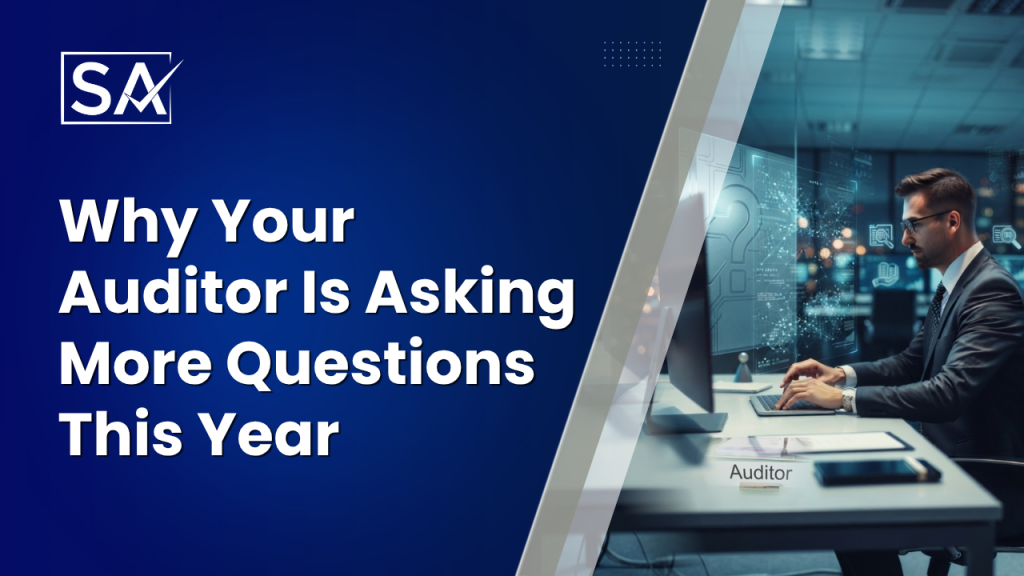
Why Your Auditor Is Asking More Questions This Year
Picture this. Last year your audit wrapped up in three weeks. This year the auditors have asked for your access logs, a walkthrough of your billing system, an explanation for a journal entry from December 29, and a meeting with your IT manager. You start to wonder: do they suspect something?
Almost certainly not. If your auditor is requesting more documents, asking deeper questions, or spending more time understanding your business, you are in good company. Across every industry, audits have become more detailed. Not because auditors enjoy making life difficult, but because business itself has become far more complex than it was even five years ago.
Here is what is really going on behind those questions.
1. Your Business Runs on Technology Now, So the Audit Does Too
Think about how an invoice got recorded ten years ago. Someone typed it into the accounting system, a manager signed off, and a paper trail sat in a filing cabinet. Today that same invoice might be scanned by software, matched to a purchase order automatically, approved through a workflow tool, and posted to a cloud system without a single human touching it.
That is wonderful for efficiency. But it changes what the auditor has to check. If a computer posted the entry, the auditor cannot just ask “who approved this?” They now have to ask “does the system that approved this actually work correctly, and who can change its settings?”
So expect questions like these. How is your financial data actually created? Are your automated controls reliable? Who has access to the accounting system, and could anyone override it? Does any AI or automation feed into your financial reports?
These are not trick questions. Auditing standards, particularly ISA 315 on identifying and assessing risks, now require auditors to genuinely understand your systems and IT environment before they even plan their testing. An auditor who skips this step is not doing their job.
2. Regulators Are Watching the Auditors Too
Here is something many business owners do not realize: auditors get audited as well. Regulators regularly inspect audit files, and firms that cut corners face penalties, public criticism, and in serious cases the loss of their license.
One thing inspectors repeatedly criticize is lazy auditing. Copying last year’s working papers. Accepting management’s explanation at face value. Writing “discussed with the CFO, appears reasonable” and moving on.
That era is over. Today your auditor is expected to independently verify significant transactions, estimates, and judgments. So when they ask you to prove something you have already explained verbally, they are not calling you a liar. They are building a file that can survive an inspection.
A simple example: you tell your auditor that a slow moving stock of goods will sell by June. A decade ago, that sentence might have been enough. Today they will likely ask for sales orders, past sales patterns, or prices of similar goods in the market. Same conclusion, much stronger evidence.
3. Fraud Questions Are Standard, Not Personal
This is the part that makes owners and CFOs most uncomfortable, so let us be direct about it. Every audit, everywhere in the world, must consider the risk of fraud. It is built into the standards. Your auditor asks these questions to every single client, including the ones they have trusted for twenty years.
The classic focus areas have not changed much: revenue recognition, related party transactions, management override of controls, and unusual journal entries.
So you may hear questions like these. Why did revenue jump sharply in the last quarter? How did you decide the price for that sale to a company owned by a family member? Why were manual journal entries posted two days before year end? What supports the assumptions behind this estimate?
Here is a useful way to think about it. When a doctor asks whether you smoke, they are not accusing you of anything. They are following a checklist designed to catch problems early. Fraud questions in an audit work exactly the same way. Honest answers with good documentation make them pass quickly.
4. AI Found Something Interesting, and a Human Has to Follow Up
Many audit firms now use AI tools to scan every transaction you posted during the year, not just a small sample. These tools are very good at surfacing oddities: a payment posted at 2 am, a round figure sitting just under an approval limit, or a supplier that shares an address with an employee.
Most of these turn out to be perfectly innocent. The 2 am entry was an automated system job. The round figure was a genuine contract price. But regulators are clear that AI supports professional judgment rather than replacing it, so a human auditor must follow up on every flag, understand it, and document the explanation.
This means you may face oddly specific questions this year. “Can you explain journal entry 4471 posted on a Sunday?” is not a sign of suspicion. It usually means the software flagged it and someone has to close the loop.
5. All These Questions Actually Work in Your Favor
It is easy to see a demanding audit as a cost and a headache. But there is a real return on it.
A thorough audit often surfaces things management genuinely wants to know. Maybe five former employees still have access to the payment system. Maybe one person can both create a supplier and approve payments to it, which is exactly how many internal frauds start. Maybe a spreadsheet everyone relies on has a formula error that has been quietly misstating margins.
And beyond your own walls, a rigorous audit gives your bank, your investors, and your board real confidence in your numbers. When a lender knows your financial statements were properly challenged, conversations about credit tend to go more smoothly.
Final Thoughts
An audit is not just a compliance ritual to survive once a year. The growing list of questions reflects a profession adapting to new technology, tougher regulation, and higher expectations from everyone who relies on financial statements.
The good news is that you control how painful the process is. Keep your documentation organized during the year rather than reconstructing it in January. Fix control gaps when the auditor points them out instead of hearing about them again next year. Respond to requests promptly, and ask your auditor to explain the purpose of a request whenever it seems odd. Good auditors are happy to tell you why they need something.
The more open and prepared you are, the faster the audit moves, and the more those questions start to feel like what they really are: a health check for your business, not an interrogation.

Why Choose Spectrum Auditing?
At Spectrum Auditing, we go beyond just being an auditing firm; we’re your trusted partner in navigating the ever-evolving landscape of UAE regulations. Here’s what sets us apart:
- Unparalleled Expertise: Our team consists of accredited auditors, management accountants, consultants with in-depth knowledge of UAE laws, ensuring your business remains compliant.
- Streamlined Solutions: We take a comprehensive approach, guiding you through every step of the process, from risk assessment to filing reports.
- International Recognition: Be audits or any type of compliance, we adhere to the highest standards (ISA, IAS, IFRS), providing global credibility.
- Personalized Support: We understand every business is unique. We tailor our services to address your specific needs and answer any questions you may have.
Partner with Spectrum Auditing today. Let’s focus on your success, while you focus on what you do best – running your business.
Contact us today for a consultation at +971 4 2699329 or email [email protected] to get all your queries addressed.